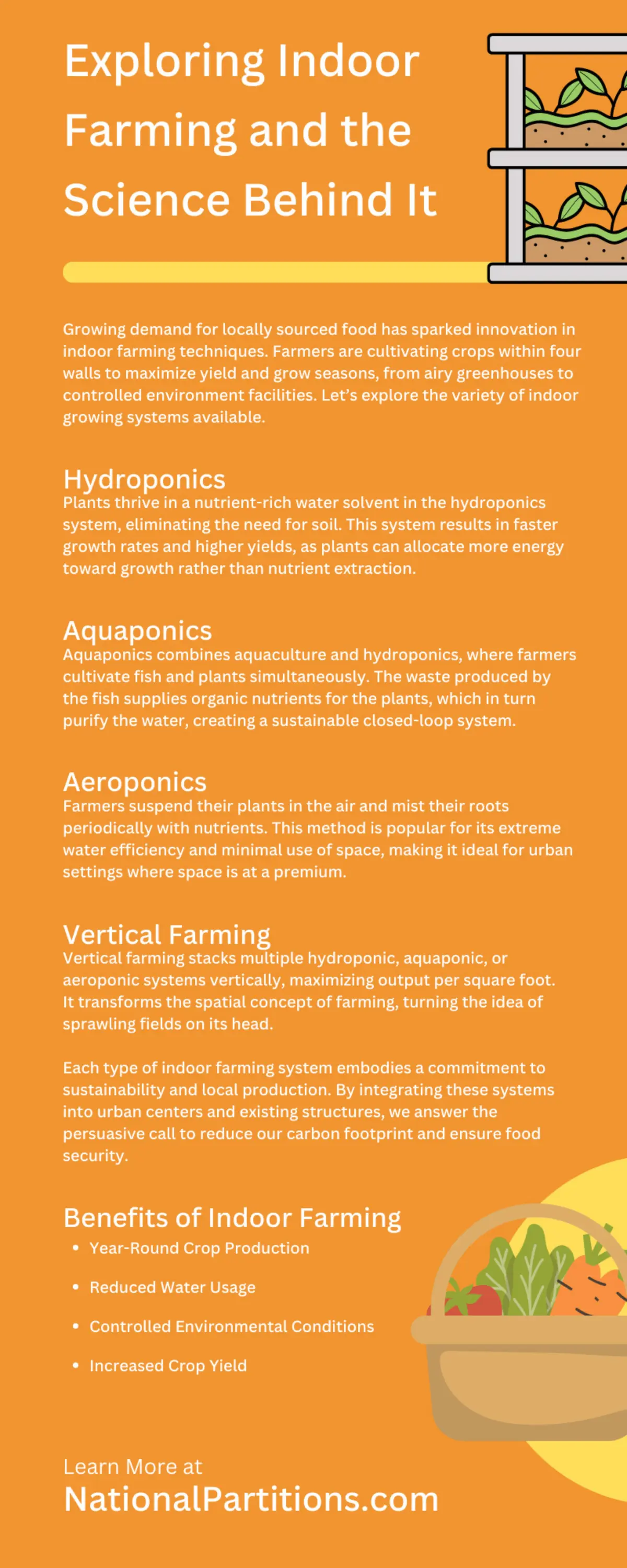
Indoor farming is the practice of growing crops inside a controlled environment instead of an open field, and it is one of the most innovative, fast-growing sectors in agriculture today. Growing plants indoors without natural sunlight can seem strange at first, but the science behind it is compelling.
Indoor farmers grow crops year-round with higher yields than traditional outdoor farms. They do it with technologies like LED lighting and carefully controlled environments, using a fraction of the water and land.
This approach could transform the food system and help address serious challenges such as climate change, urbanization, and population growth. Below, we explore indoor farming and the science behind it to show the possibilities it opens for agriculture.
What Is Indoor Farming?
Indoor farming, also called vertical farming or controlled-environment agriculture (CEA), is growing crops indoors in a managed space that is typically free from pests and harsh weather. Its main appeal is that farmers can grow fresh produce year-round, independent of the outside climate, which makes it a more efficient and effective method.
What Are the Main Types of Indoor Farming?
The main types of indoor farming are hydroponics, aquaponics, aeroponics, and vertical farming. Growing demand for locally sourced food has driven innovation in all of them. From airy greenhouses to controlled-environment facilities, farmers now cultivate crops indoors to maximize yield and extend growing seasons.
Hydroponics
In a hydroponic system, plants grow in a nutrient-rich water solution with no soil. Growth rates are faster and yields higher, because plants spend more energy on growth and less on extracting nutrients.
Aquaponics
Aquaponics combines aquaculture and hydroponics so farmers raise fish and plants together. Fish waste supplies organic nutrients to the plants, and the plants purify the water, creating a sustainable closed-loop system.
Aeroponics
In aeroponics, plants hang suspended in the air while their roots are misted with nutrients at regular intervals. The method is known for extreme water efficiency and a small footprint, which suits urban settings where space is at a premium.
Vertical Farming
Vertical farming stacks multiple hydroponic, aquaponic, or aeroponic systems on top of one another to maximize output per square foot. It reverses the traditional idea of farming as sprawling fields.
Every type of indoor farming system reflects a commitment to sustainability and local production. Placing these systems in urban centers and existing structures helps reduce carbon footprints and strengthen food security.
What Are the Benefits of Indoor Farming?
Indoor farming delivers year-round harvests, lower water use, precise environmental control, and higher yields, overcoming the limits of traditional field farming. Rising populations strain limited land and resources. Climate change brings unpredictable weather, and pesticide use and food contamination remain concerns. Indoor vertical farming offers an innovative answer to all of these. Here are its key benefits.
Year-Round Crop Production
Seasonal changes no longer dictate which crops are available. Indoor farms produce vegetables, fruits, and herbs consistently throughout the year, which creates a more reliable supply and reduces dependence on weather patterns.
Reduced Water Usage
As water use becomes a growing concern, growing crops with far less water is a major benefit. Hydroponics and aeroponics use only a fraction of the water that traditional soil-based agriculture requires.
Controlled Environmental Conditions
Precise control over the factors that drive plant growth is one of the biggest advantages of indoor farming. Growers can closely monitor temperature, humidity, and carbon dioxide levels. With that control, farmers create optimal growing conditions and tailor each environment to the needs of different crop types.
Increased Crop Yield
Indoor farming methods can produce crops at a much higher rate than traditional farming. Stacking crops vertically makes the most of available space, and the controlled environment speeds growth and allows multiple harvests each year.
How Does the Science of Indoor Farming Work?
Indoor farming works by tightly controlling environmental factors such as temperature, humidity, and light to optimize plant growth. Technologies like hydroponics and aeroponics replace traditional soil cultivation. The sections below take a closer look at what makes indoor farming so successful.
Artificial Lighting and Plant Growth
Light is one of the most fundamental requirements for plant growth. Specialized LED lighting delivers a custom light spectrum that maximizes photosynthesis and supports plant development when natural light is limited or unavailable. These lighting systems keep evolving, becoming more energy-efficient and better matched to the biochemistry of individual plants.
Nutrient Delivery Systems
Plants on indoor farms receive nutrients through precise delivery systems. In hydroponic systems, plant roots sit in direct contact with nutrient-rich water. This feeds crops very efficiently and removes the competition for nutrients found in traditional soil.
Soilless Cultivation Techniques
Indoor farms replace traditional soil with growing media that support plant growth. Peat moss, coconut coir, and rock wool are common examples. They give roots mechanical support and retain moisture and nutrients effectively.
Automation and Robotics
Many indoor farms run with minimal human intervention thanks to advanced automation. Robotics streamlines planting, monitoring, harvesting, and environmental control, making farming more precise and space-efficient.
Is Indoor Farming Environmentally Sustainable?
Yes. Indoor farming reduces the use of pesticides and fertilizers, which contributes to cleaner rivers, lakes, and ecosystems. Bringing indoor farming into modern agriculture reflects human innovation and is a crucial step toward environmental sustainability. Rather than a simple alternative, indoor farming is a transformative influence on current agricultural practices and supports the conservation of the planet's resources.
The Future of Indoor Farming
Indoor farming is built on innovation. With science driving progress, it can deliver sustainable, efficient, and local solutions for growing food needs. Beyond changing how food is grown, it opens new possibilities for agricultural engineering and design.
Looking ahead, modular structures will play a significant role in supporting indoor farming operations. National Partitions offers modular in-plant offices that serve as command centers for indoor farms. These offices give workers a controlled environment within the farm, separated from the more sensitive growing areas.